Louvered Covers and Screens for Sun, Wind and Sideways Rain
Fixed roofs do one job well. Louvers and screens let you change the patio as the weather changes.
October 15, 2026 · 4 min read
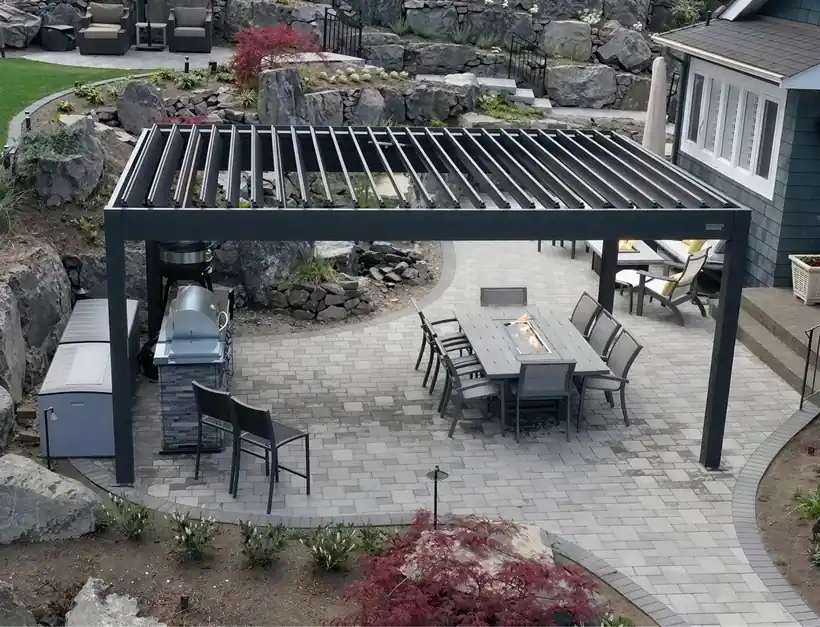
A fixed patio roof has one setting. It's there, it covers a patio, and it stays the same whether the day is bright, blustery or soaked. In the Puget Sound area the weather often changes three times before lunch, so some homeowners want a cover that can adjust. Two product lines that Action Installations LLC installs are built around that idea: PERGOLUX louvered covers and Templar screens.
What a louvered cover does
A louvered cover has a roof made of slats, called louvers, that rotate. The company describes the PERGOLUX system this way: open the roof louvers to enjoy sunlight and fresh air, adjust them for comfortable shade, or close them for added overhead protection when the weather changes. They install these systems for patios, decks and outdoor gathering spaces throughout the Greater Puget Sound and select Eastern Washington communities.
The practical effect is that one structure covers several moods. On a clear June evening you tilt the louvers to let the low sun through. On a hot afternoon you angle them for shade while keeping air moving. When the sky turns gray and a front rolls in, you close the roof. The company puts it plainly: a louvered cover gives you more control over your patio than a traditional fixed-roof structure.
Rain management, and the honest caveat
When the roof is closed, the overlapping louvers and an integrated drainage system are designed to help channel water away from the covered area. That's the company's description, and they follow it with a caveat worth repeating: "Performance will depend on the selected model, configuration, site conditions, and installation."
That's the right way to think about any roof that moves. Rain handling isn't a single yes or no. It depends on which model you choose, how the structure is laid out, where it sits on your property and how well it's installed. When you get an estimate, ask how water leaves the structure at your particular site and talk through what you'd expect during a hard southerly blow.
Manual or motorized
You can choose from available manual or motorized systems. Manual means you operate the louvers by hand, which suits a simple setup where you adjust them once or twice a day. Motorized means you press a button or use a remote. The company also notes that select PERGOLUX models may support features such as integrated lighting, screens, walls, heaters, app controls and smart-home connections. Which of those are available depends on the model, so ask which ones apply to the one you're considering.
The louvered look is also distinct from a solid roof. In photos of the company's work, a louvered cover over an outdoor kitchen and stone patio reads as architecture, not just shelter. If your house has clean modern lines, that's a real advantage.
Where Templar screens fit in
The company partners with Templar Screens for roll down shades, sun screens and wind blocks. These solve a different problem. A roof handles what falls from above. Screens handle what comes in from the side, and in this region a lot of the weather arrives from the side.
Roll down shades are described as designed for effortless light control and privacy, smoothly operated and neatly retractable. Sun screens are meant to protect a space from harsh sunlight while maintaining the view and natural light, reducing glare and heat without darkening the room. Wind blocks are designed to reduce gusts while maintaining visibility and airflow, ideal for patios, balconies, pergolas and open structures.
There's a video on their site of retractable patio screens drawing back to reveal a waterfront view, which is a good image for how the product works. The screen is down when you want shelter, and up when you want the view.
Sideways rain and gusty days
Anyone who lives near the water knows that rain on a windy day doesn't fall, it travels. A roof alone won't keep a patio fully dry when the weather comes in sideways. Side protection, whether that's a screen, a wall or a wind block, changes how far back into the patio the weather reaches. Wind blocks reduce gusts rather than sealing off the space, so set your expectations accordingly and ask the installer what to expect for your site.
Direction matters too. Take a week and notice which way the wind and rain come from at your house. On most properties it's from one or two directions, and that tells you where a screen or wall would do the most good.
Choosing between a fixed roof, louvers and screens
- A fixed roof makes sense when you mostly want constant cover and the simplest structure.
- A louvered cover makes sense when you want to control light and airflow through the day.
- Screens make sense when sun, glare or wind from the side is the main problem.
- A combination of a louvered roof with screens on the exposed sides is possible for a more complete setup.
The team at Action Installations LLC has been installing covers around the Puget Sound since 1992. If you'd like to see how louvers or screens would work on your patio in Orting or anywhere from Everett to Olympia, call (253) 886-3525 for a free estimate. They'll come to your house and walk through the options in person.
Action Installations LLC, (253) 886-3525
Call (253) 886-3525More articles
Glass, Polycarbonate, Aluminum or Insulated: Picking a Patio Cover Material
The right roof material depends less on the catalog and more on whether the room behind it needs daylight or shade.
Living Under a Patio Cover Through a Puget Sound Winter
A good cover turns the wettest months into patio months, and the upkeep is lighter than most people expect.